72 hr
Private 3-Day Golden Triangle Tour from Delhi
- Private experience
- Personal attention
- Premium amenities
- Free cancellation
Golden Triangle India Tour Packages from Delhi — Private & Luxury Itineraries
Delhi's monuments, Agra's marble mausoleum, Jaipur's amber halls, three cities in one curated circuit
Compare fares, pick the fit — all bookings are mobile-voucher and eligible for free cancellation where shown.
72 hr
96 hr
120 hr
Selecting the right pass for your golden triangle india tour packages from delhi requires deciding if you wish to view the monument's exterior gardens or access the inner burial chambers. These Agra landmark tickets ensure your visit to the UNESCO heritage site matches your expectations for historical depth.
| Standard Entry Complex Access |
Top pick Full Mausoleum Access Interior Chamber |
|
|---|---|---|
| Conservation Fee | 1,100 INR | 1,100 INR |
| Mausoleum Entry | — | 200 INR |
| Access Areas | Gardens and Platform | Gardens, Platform, Mausoleum |
| Valid Period | Single Entry | Single Entry |
| Best For | Budget Visitors | First-time Visitors |
| See tickets & prices |
Verdict: For the most complete experience on your golden triangle india tour packages from delhi, select the Full Mausoleum Access ticket to see the interior cenotaphs.
Worth it for hassle-free multi-city exploration
Golden triangle india tour packages from delhi eliminate the logistical complexity of coordinating transport, accommodation, and guides across three cities in a single trip. Private 3-day packages typically start around ₹15,000–₹25,000 per person, while 4-day luxury options climb to ₹35,000–₹50,000, covering Delhi's Red Fort and Qutub Minar, Agra's Taj Mahal, and Jaipur's Amber Fort with air-conditioned vehicles and English-speaking guides. DIY travel demands separate train bookings, hotel research in each city, and on-the-ground negotiation with auto-rickshaw drivers and touts—feasible but time-consuming for first-time visitors unfamiliar with regional transport schedules. Pre-arranged tours absorb that friction, delivering fixed-route itineraries with guaranteed pickups and monument entry management. The value proposition holds strongest for travelers prioritizing convenience over budget flexibility: you pay a premium for curated routing and centralized coordination, which matters most on short timelines or when traveling with family. Independent travelers comfortable navigating Indian Railways and booking heritage hotels directly can replicate the route for 40–50% less, though the time cost of planning remains real.
Bottom line: Golden triangle india tour packages from delhi tours trade budget savings for logistical certainty—worth the premium if your timeline is tight or this is your first India visit.
They complement each other; most visitors who do both call the Rajasthan extension the more immersive and diverse experience for those with extra time.
|
Top pick Golden Triangle Tour |
Rajasthan Heritage Tour | |
|---|---|---|
| Duration | 3–6 days | 7–14 days |
| Primary Focus | Mughal monuments & capital city | Royal forts, desert & palace stays |
| Travel Intensity | Compact & low-stress | Higher with longer road journeys |
| Best For | First-time visitors to India | Deep culture & desert exploration |
| Landscape Variety | Urban centers & plains | Desert, hills & lake towns |
| Typical Pace | Fast-paced & efficient | Relaxed & immersive |
| See tickets & prices |
Verdict: Choose the golden triangle india tour packages from delhi for a quintessential, time-efficient introduction to India's most iconic landmarks, or opt for the Rajasthan circuit if you prefer a deeper, slower-paced exploration of royal heritage and diverse desert landscapes.
Hand-picked experiences loved by thousands of travelers
3 days
Free Cancellation
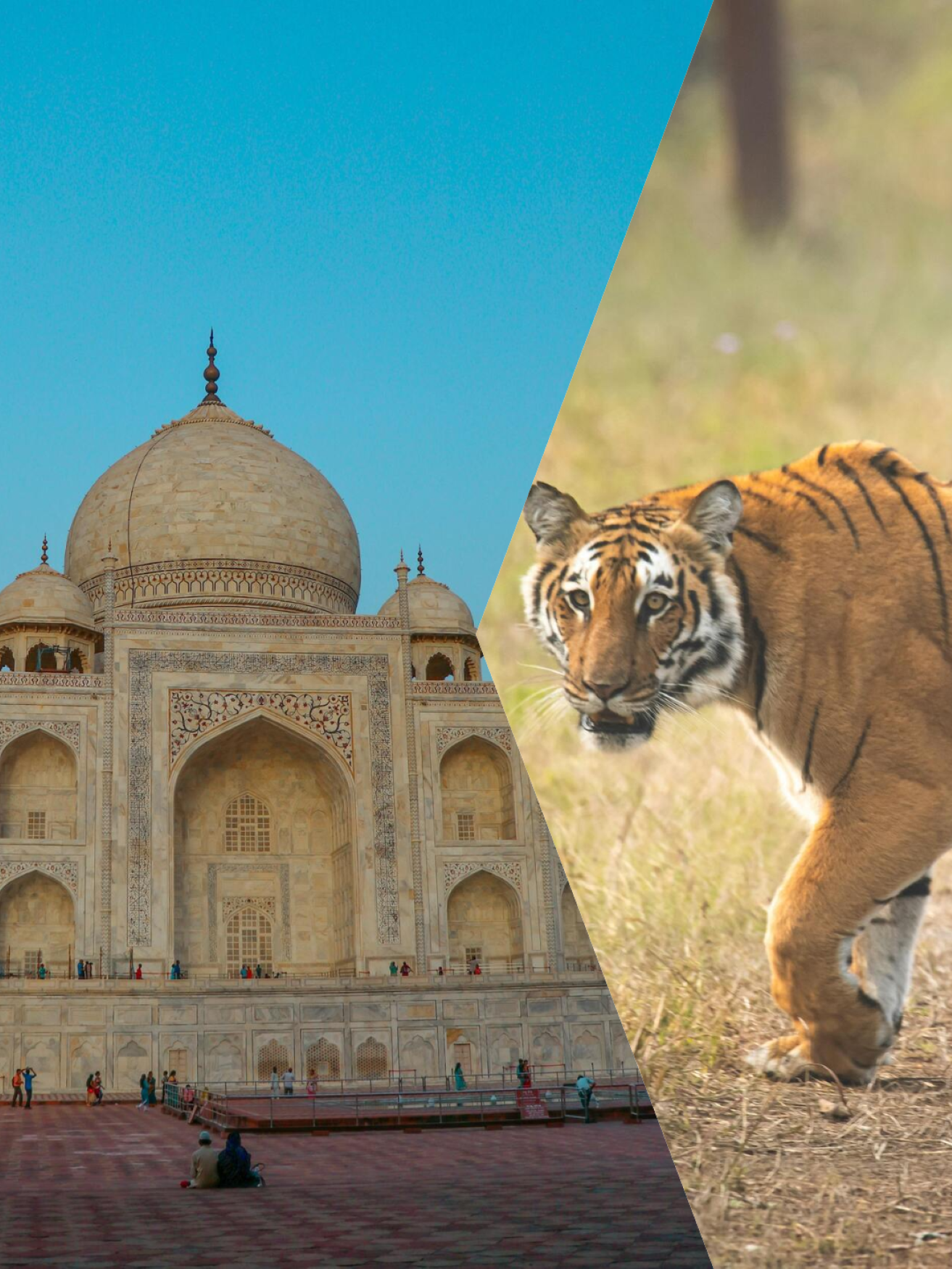
Explore India's iconic cities and hunt for Bengal tigers on this epic multi-day adventure
6 days
Free Cancellation
Experience India's iconic monuments and wildlife: Delhi, Agra's Taj Mahal, tiger safaris, and Jaipur's palaces
3 - 5 days
Free Cancellation
Private journey through Delhi, Agra & Jaipur with optional Ranthambore wildlife excursions
2 days
Free Cancellation
Discover India's iconic monuments on a private two-day journey through Agra and Jaipur with expert guides
3 days
Free Cancellation
Three-day curated journey through India's most celebrated cities with personal guide and transport
4 days
Free Cancellation
Discover Delhi, Agra, and Jaipur with private transport, guides, and optional accommodation on this classic route
2 days
Free Cancellation
Discover India's crown jewels—the Taj Mahal, Agra Fort, and Jaipur's palaces—on a two-day adventure.
Proceed through the West Gate towards the main plaza
Walk the Charbagh symmetry towards the reflecting pool
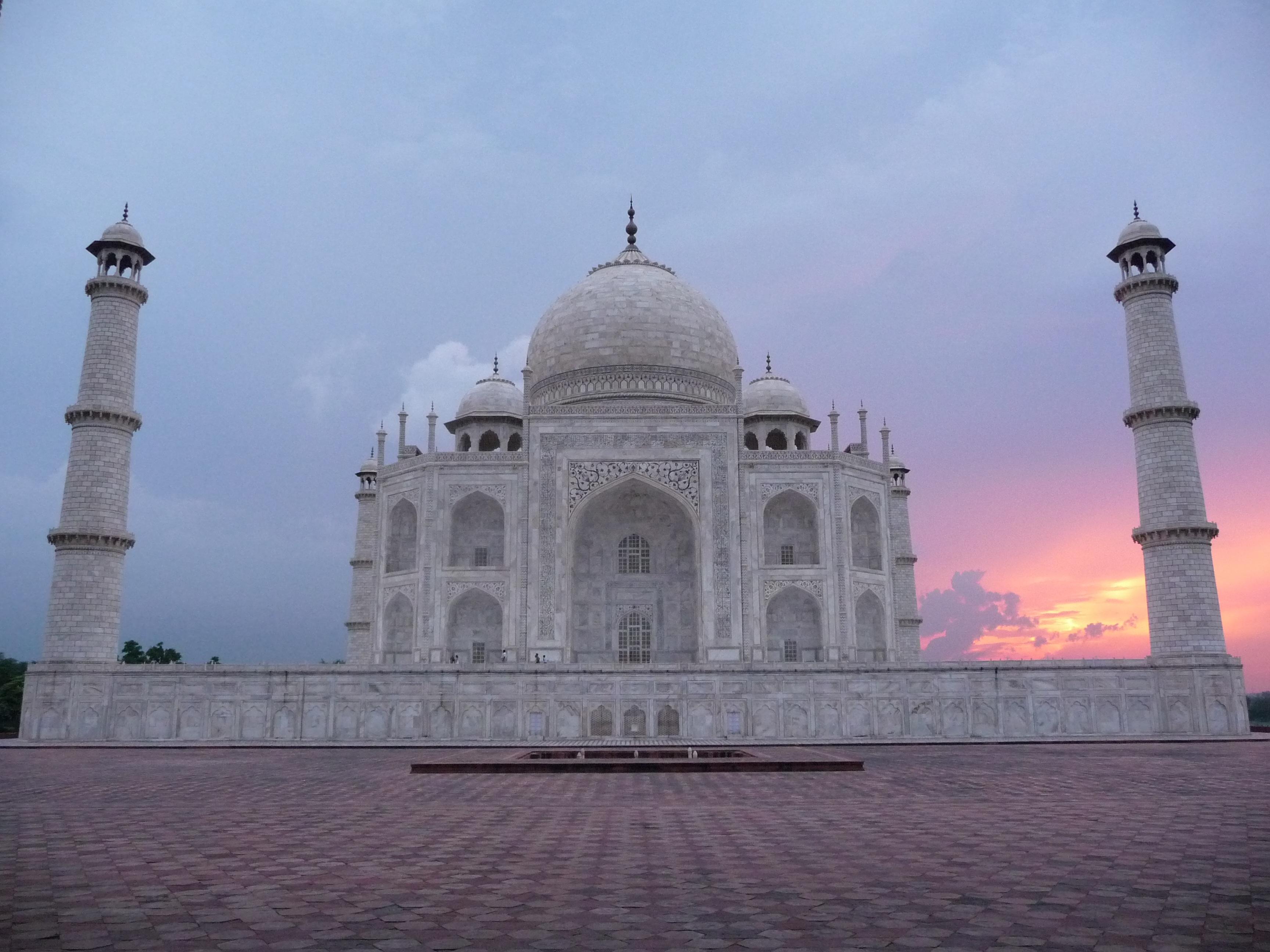
Observe the white marble facade from the main platform
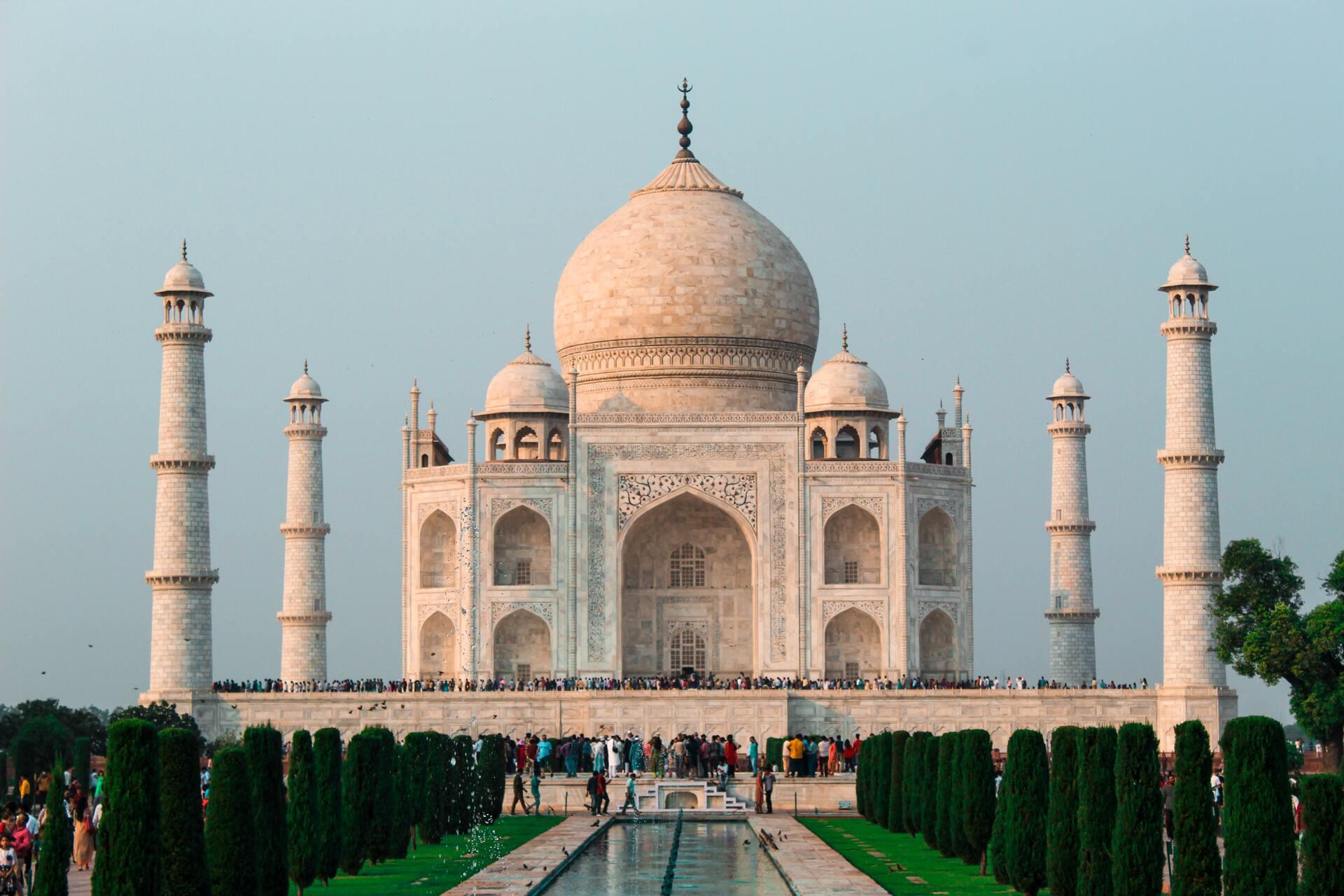
A white marble tomb housing the graves of Shah Jahan and Mumtaz Mahal. It features intricate pietra dura inlay work using semi-precious stones.
A classic Persian-style garden divided into four quadrants by water channels. The symmetry is designed to reflect the heavens on earth.
The main entry point for most visitors, featuring impressive red sandstone architecture. It serves as the primary access for those on tours.
A long, narrow water body that creates the iconic mirror image of the structure. It is a central feature of the garden landscaping.
Four towers positioned at the corners of the plinth, leaning slightly outward for structural safety. They stand over 40 meters tall.
You leave Delhi before sunrise, the Grand Trunk Road still lit by dhaba cookfires, and reach Agra as the Yamuna mist lifts. At the Taj Mahal's western gate you pay the 1,100-rupee conservation fee, pass through the red sandstone forecourt, and step into the char bagh.
The white dome floats above its reflection pool, the marble surface cool even as the October sun climbs. Inside Agra Fort, you walk the ramparts where Shah Jahan spent his final years under house arrest, the Taj visible through a jali screen three kilometres downriver.
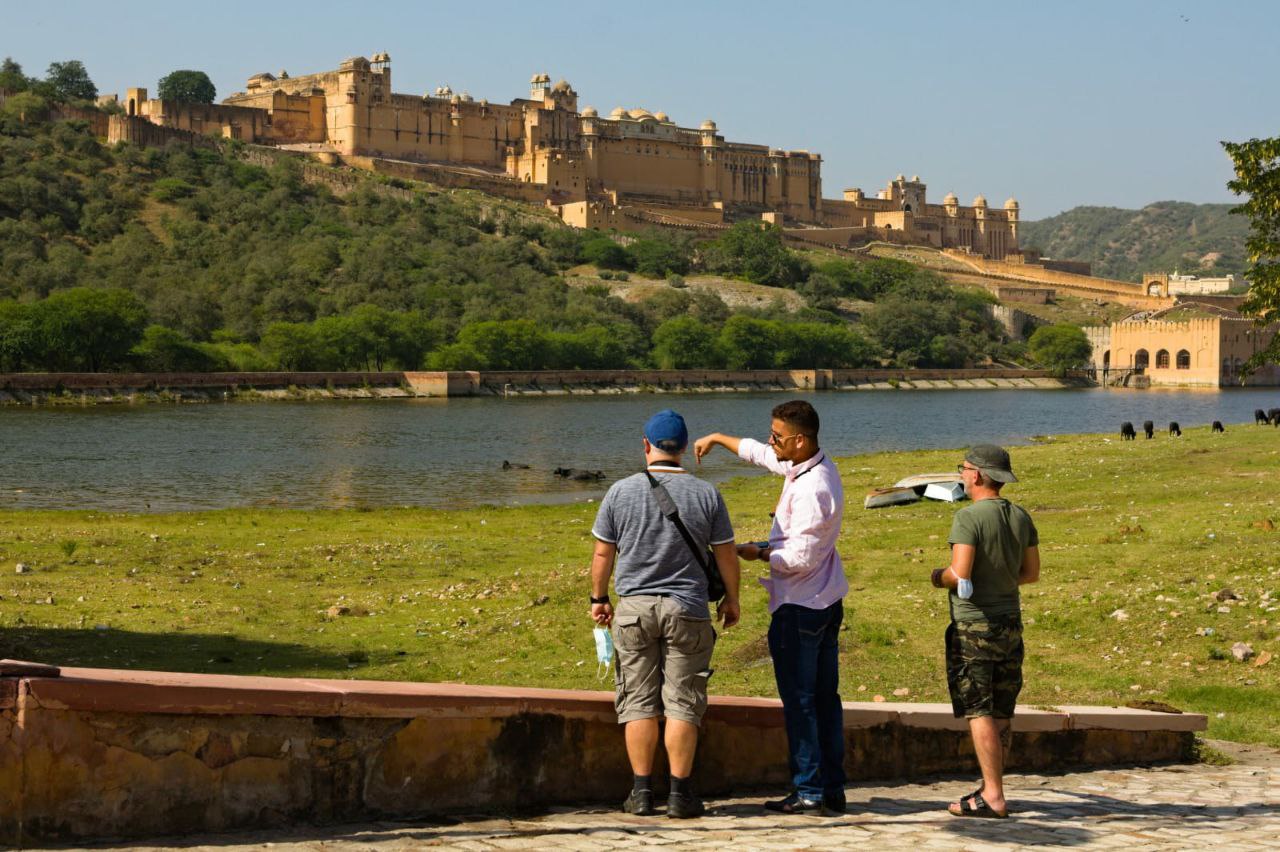
By afternoon you're on NH 21 toward Jaipur, the road narrowing through mustard fields and camel carts. You reach the Pink City by dusk, the old town's terracotta facades glowing under sodium lamps. Next morning you climb Amber Fort's elephant ramp—now walked, not ridden—and enter the Sheesh Mahal, where your guide strikes a match and the mirrored ceiling ignites. At Hawa Mahal you count the five-storey honeycomb of windows, then descend into Johari Bazaar's silver lanes. On the final day, returning to Delhi via the Aravalli foothills, you stop at a roadside haveli for masala chai, the circuit complete.
All the details about your upcoming adventure in one place
The circuit linking Delhi, Agra, and Jaipur earned its triangular nickname in the 1960s, when India's tourism ministry mapped the 720-kilometre route connecting three Mughal and Rajput seats of power.
Each vertex anchors a distinct chapter of North Indian statecraft: Delhi's Red Fort and Qutb Minar chronicle sultanate and empire, Agra's Taj Mahal and Agra Fort preserve Shah Jahan's marble lexicon, and Jaipur's Amber Fort and City Palace codify Rajput chivalry in sandstone and lattice. The triangle is not a relic but a living geography—Delhi's Chandni Chowk spice markets, Agra's pietra dura workshops, and Jaipur's block-printing ateliers continue the craft traditions that built these monuments.
Golden triangle india tour packages from delhi typically span three to six days, with private vehicles tracing National Highway 44 south to Agra (230 kilometres, four hours) and then west to Jaipur (240 kilometres, four and a half hours) before looping back to Delhi via NH 48 (280 kilometres, five hours). The longer itineraries layer Ranthambore National Park between Jaipur and Agra, adding Bengal tiger sightings and Aravalli scrubland to the Mughal-Rajput narrative. Most tours depart Delhi at dawn to reach Agra by mid-morning, when the Taj Mahal's conservation fee queue is shortest and the Yamuna River light is still diffuse.
Architecturally, the circuit juxtaposes three imperial vocabularies. Delhi's Humayun's Tomb introduced the Persian char bagh—quartered garden—that prefigured the Taj. Agra's monuments refine that grammar: the Taj's white Makrana marble inlaid with lapis, jade, and carnelian; Agra Fort's red sandstone bastions enclosing Khas Mahal's shell-motif arches. Jaipur, by contrast, speaks Rajput: Amber Fort's Sheesh Mahal multiplies a single candle flame into a constellation via convex mirror fragments, and Hawa Mahal's 953 jharokha windows allowed royal women to observe street processions unseen. The India golden triangle tour reveals not one aesthetic but a dialogue—Mughal symmetry answering Rajput asymmetry, marble responding to sandstone, garden confronting desert.

The triangle is not a relic but a living geography—spice markets, pietra dura workshops, and block-printing ateliers continue the craft traditions that built these monuments.
Visitors should dress modestly, covering shoulders and knees out of respect for this historical site. This dress code applies to all participants of golden triangle india tour packages from delhi.
Only small bags containing essential items are permitted inside the grounds. Larger backpacks and luggage are not allowed and must be stored securely outside.
Photography is permitted in the garden areas, but it is strictly prohibited inside the main mausoleum. Using tripods is not allowed for those on golden triangle india tour packages from delhi.
Families are welcome, though strollers may be difficult to navigate in some sandy areas. Children under the age of 15 are admitted free of charge for the conservation fee.
Wheelchair access is provided via specific entry paths near the main gate. Assistance may be required for certain elevated sections of the complex.
Consuming food or drinks is strictly forbidden within the monument grounds to maintain site cleanliness. Sealed water bottles are permitted for personal use.
Opening Hours
06:00–18:30
Address
Dharmapuri, Forest Colony, Tajganj, Agra, Uttar Pradesh 282001, India
Entry Fee
1,100 INR per person
Arrival Recommendation
06:00–08:00
Security
Strict bag screening enforced
Navigation
Follow signage within Tajganj
Taxi · 20 min · Varies
Private cars provide the most direct route from Agra hotels to the monument parking zones.
Walk · 10 min · Free
Those staying in Tajganj can reach the gate on foot in under 15 minutes.
Cancellations for golden triangle india tour packages from delhi tours must be requested within the operator's specified window. Refunds are issued excluding the non-refundable 1,100 INR conservation fee per person.
Recommended time
3-4 hours
Allocating this duration allows for a comprehensive experience of the white marble architecture while navigating entry security and garden paths. Planning your golden triangle india tour packages from delhi requires careful attention to the site, which is located at Dharmapuri, Forest Colony, Tajganj, Agra, Uttar Pradesh 282001, India. We recommend securing your golden triangle india tour packages from delhi tickets early to avoid long queues, as crowds increase significantly by mid-morning. Those booking specific golden triangle india tour packages from delhi tours should aim to complete their exploration before the afternoon heat peaks.
Crowd levels through the day
Weather · crowds · average price — dots go green to amber to red as each metric rises.
Cooler temperatures make this the optimal time for outdoor exploration. Daytime highs average 20°C to 25°C, perfect for long walks.
Arrive at 06:00 to capture the best morning light on the marble structures. Early entry avoids the peak heat of the day for golden triangle india tour packages from delhi.
Use the provided shoe covers before stepping onto the main marble mausoleum platform. This helps preserve the integrity of the inlaid stone floors.
Ensure your guide has official certification when booking golden triangle india tour packages from delhi. Verified guides offer better historical context.
The Golden Triangle's cultural and architectural identity emerged from successive waves of Mughal ambition and Rajput statecraft between the 16th and 18th centuries. Delhi became the Mughal capital when Humayun returned from Persian exile in 1555, bringing with him the architectural synthesis of Timurid domes and Indian craftsmanship. His son Akbar consolidated power by building Agra Fort in 1565, transforming the city into the empire's administrative heart. Shah Jahan, ascending in 1628, commissioned the Taj Mahal as a mausoleum for Mumtaz Mahal, completed in 1653 after twenty-two years of labor by twenty thousand artisans. The white marble structure drew on Persian, Ottoman, and Indian design vocabularies, establishing Agra as the empire's symbolic center. Jaipur entered the triangle's orbit later, founded in 1727 by Maharaja Sawai Jai Singh II as a planned city grid based on Shilpa Shastra principles. Unlike the older capitals, Jaipur was conceived as a rational urban experiment, with nine rectangular sectors and wide bazaars designed to accommodate trade caravans. The city's pink sandstone facades, mandated in 1876 for the Prince of Wales's visit, became its enduring visual signature. While Delhi and Agra reflected Mughal cosmopolitanism, Jaipur embodied Rajput mathematical precision and mercantile pragmatism, creating a dynastic counterpoint within the region. The term "Golden Triangle" emerged in modern tourism marketing during the 1980s, when the Indian government identified the Delhi-Agra-Jaipur circuit as a compact showcase of Mughal and Rajput heritage accessible within a single itinerary. The circuit's geometry—roughly equilateral at 200 to 250 kilometers per leg—allowed travelers to experience three distinct architectural traditions without long overland transit. Today, golden triangle india tour packages from delhi remain the country's most-traveled heritage route, anchored by monuments that survived colonial neglect, partition-era turmoil, and twentieth-century urbanization. The Taj Mahal alone draws eight million visitors annually, sustaining Agra's conservation economy and defining the triangle's global brand.
Humayun re-establishes Mughal rule in Delhi after defeating Sikandar Shah Suri
Akbar completes Agra Fort, consolidating the city as the empire's military and administrative center
Shah Jahan finishes the Taj Mahal after 22 years of construction employing 20,000 artisans
Maharaja Sawai Jai Singh II founds Jaipur as a planned city based on Shilpa Shastra grid principles
Jaipur's sandstone buildings are painted pink to welcome Edward, Prince of Wales, creating the city's signature palette
The Taj Mahal is inscribed as a UNESCO World Heritage Site, anchoring international recognition of the circuit
Indian tourism authorities brand the Delhi-Agra-Jaipur route as the "Golden Triangle" for heritage marketing
Annual Taj Mahal visitation surpasses 7 million, making the Golden Triangle India's most-visited heritage corridor
Position your camera at the far end of the marble walkway to capture the symmetry of the mausoleum and its reflection in the water. This is the most iconic angle for golden triangle india tour packages from delhi photography.
Walk to the back garden area to capture the Taj Mahal framed against the Yamuna River during the early morning haze. This location is popular for golden triangle india tour packages from delhi tours to see the structure from an alternative perspective.
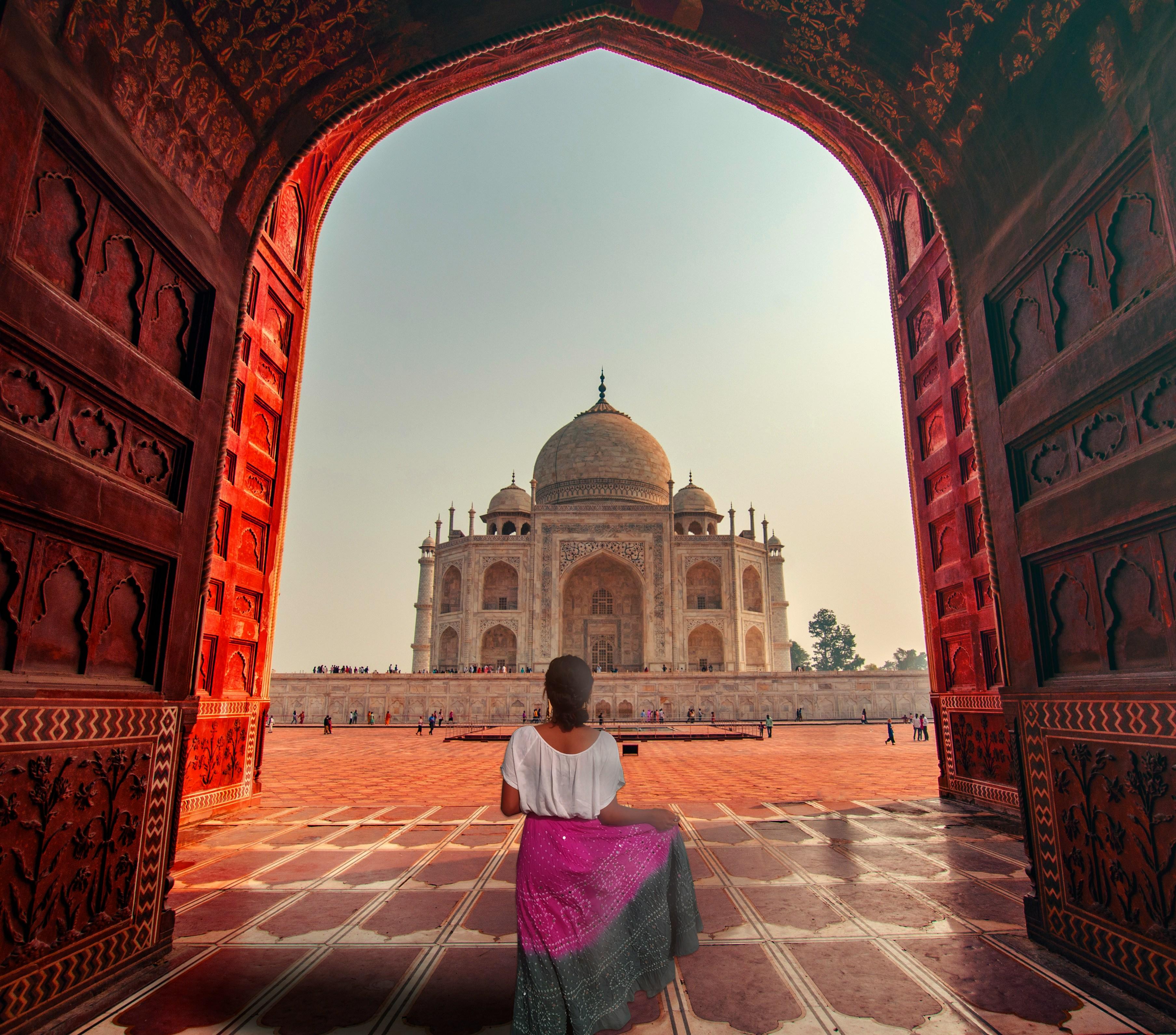
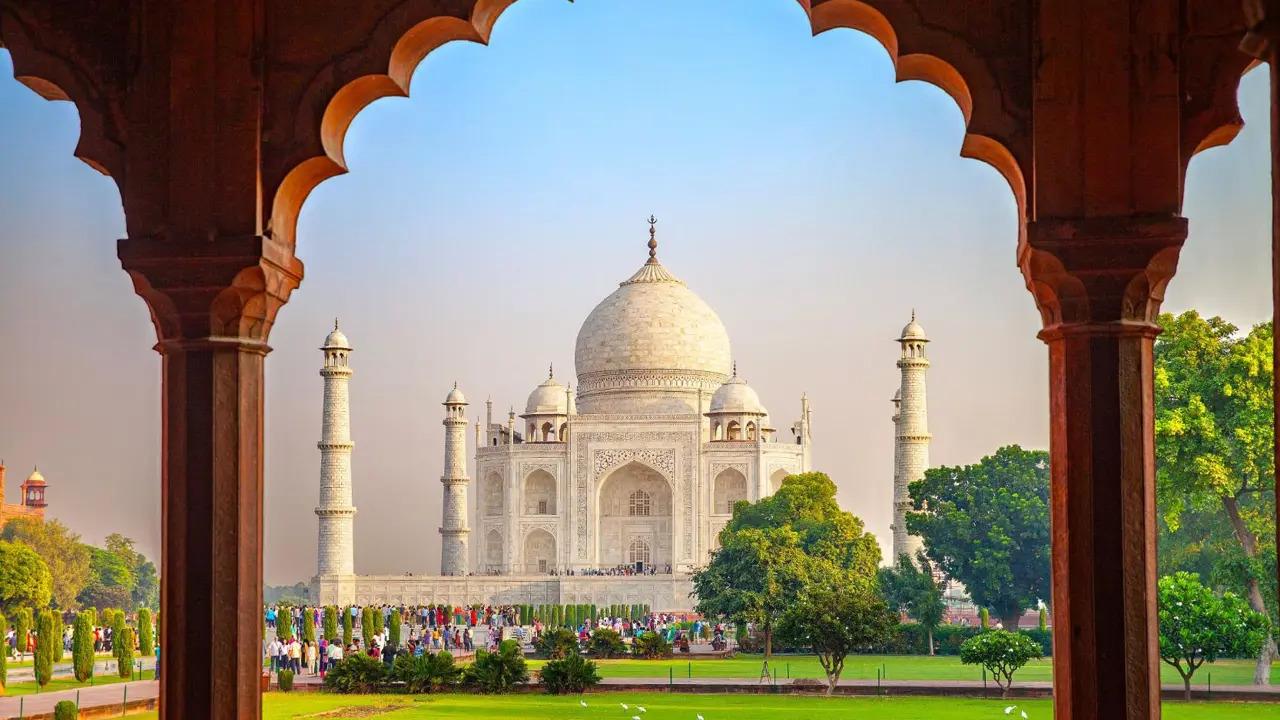
Stand near the entrance archway to capture the Taj Mahal through the stone frame for a sense of scale. Many golden triangle india tour packages from delhi tickets holders use this spot to create architectural depth in their images.
Position yourself along the central garden axis to include the manicured hedges and cypress trees leading toward the white marble edifice. This classic composition is a staple of the golden triangle india tour packages from delhi tour experience.
Exploring this iconic white marble monument as part of your golden triangle india tour packages from delhi requires careful planning to ensure children remain comfortable. Navigating the sprawling gardens and stone pathways is most manageable when families prioritize early morning visits to avoid crowds.
Strollers are permitted and useful for navigating the long, flat approach paths, though you must carry them up the steps to the main plinth. Many families choose golden triangle india tour packages from delhi tours that offer private transport to minimize walking distances between the parking zone and the entry gates.
Baby-change facilities are limited on-site, so it is best to prepare your supplies before entering the complex. Public restrooms are located near the entry gates, but we recommend utilizing amenities at your hotel before departing for your golden triangle india tour packages from delhi tour.
Given the large site, plan for a relaxed pace to keep children engaged with the symmetrical reflecting pools rather than rushing through the grounds. Securing your golden triangle india tour packages from delhi tickets in advance helps minimize wait times, allowing you to focus on the experience rather than logistics.
School-aged children typically appreciate the scale of this UNESCO heritage site, while toddlers benefit from the open spaces of the Charbagh gardens. Shade is limited, so keep younger visitors protected from the sun during your visit to these famous Agra landmarks.
Dining options near the Taj Mahal allow travelers on golden triangle india tour packages from delhi to experience authentic Mughlai cuisine. While no food is permitted inside the complex, several reputable establishments are located within a short walk of the Tajganj entrance.
Famous for its North Indian curries and tandoori platters, this venue is a staple for those finishing their Taj Mahal landmarks tour. It offers a refined atmosphere suitable for groups booked on golden triangle india tour packages from delhi tours.
Everything you need to know for your journey
The monument is open from 06:00–18:30 daily except Friday. Please verify these hours before planning your golden triangle india tour packages from delhi visit.
Yes, this iconic landmark is a staple of golden triangle india tour packages from delhi. Visitors typically spend several hours exploring the complex.
The 1,100 INR conservation fee is the standard entry requirement per person. Always check if your package includes this fee or requires separate payment.
Yes, bookings for golden triangle india tour packages from delhi can be made through official digital platforms. Always secure your golden triangle india tour packages from delhi tickets in advance.
Yes, please dress modestly out of respect for the site. This is a common requirement for all golden triangle india tour packages from delhi.
The best arrival window is 06:00–08:00 to avoid heat and crowds. This ensures the best experience for your golden triangle india tour packages from delhi itinerary.
Only small bags are permitted inside. Larger items must be left at the designated storage areas outside the Taj Mahal entrance.
Photography is allowed in the gardens, but prohibited inside the mausoleum. Please respect these rules during your golden triangle india tour packages from delhi.
A red sandstone fortress containing historical palaces.
A charbagh complex offering sunset views across the river.
An intricate tomb often called the Baby Taj.
Luxury hotel with direct monument views.
Well-located hotel with rooftop dining.
Expansive property with traditional design elements.
Join thousands of happy travelers who have discovered this incredible experience
Book Your Experience Now